
Do Things That Scale
(Even If You’re Not the Boss)


There’s a well-worn phrase in the startup world that says, “Do things that don’t scale.”
It’s advice meant for early-stage founders, encouraging them to do the messy, manual, high-touch work required to delight their first 10 or 100 users before obsessing over automation. That phrase has its place. But if you’re a CSM, a team lead, or even a first-year IC looking to level up, there comes a point where the inverse becomes your north star.
You’ve got to do things that scale.
This doesn’t mean you ignore nuance or stop caring. It doesn’t mean you automate everything or distance yourself from your customers. What it does mean is this:
You begin to approach your work like a system, not a series of tasks.
You start investing in reusable assets, repeatable processes, durable outcomes. You stop being the hero in every firefight and instead build the water system so the fire doesn’t start. And most of all, you stop measuring yourself by how busy you are, and instead by how much leverage you create.
Let’s talk about what that actually looks like, why it matters (especially if you’re an IC), and how to get started.
Why Scale Isn’t Just a “Leader” Problem
Too many individual contributors wait to think about scale until they’re in management. They think:
“Scaling? That’s for org-wide programs.”
“I just manage a book of accounts. I’m not designing systems.”
“I need to do what’s in front of me—I’ll optimize later.”
But that mindset will keep you trapped in the tactical forever.
The truth is: scale starts with you. No matter your title. No matter your book size. In fact, the best CSMs and CS leaders I’ve seen didn’t wait for permission to think big. They first scaled themselves, before they ever scaled a team.
And when they did, something remarkable happened:
They created time, which made room for strategic work and stretch assignments, which then got them noticed. That’s how scale works.
Scale Looks Different Depending on Where You Sit
Let’s break it down. “Doing things that scale” means different things depending on your role and your vantage point. Here’s what it can look like:
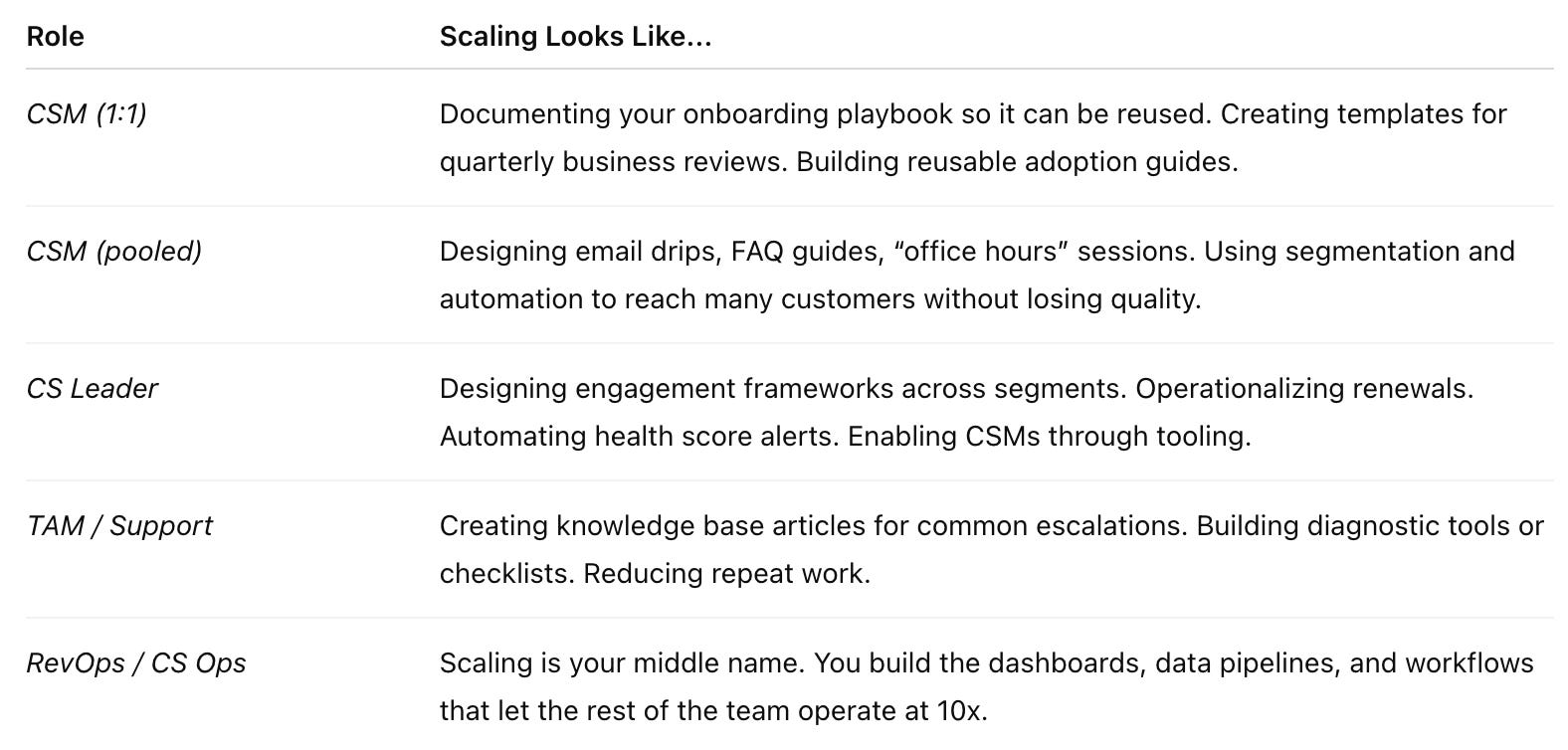
It’s about your posture, not your title.
Scale Is a Mindset, Not Just a Mechanism
Let me be clear: scale is not about automation alone. It’s not about adding tools, creating macros, or sending batch emails. Those are merely outputs.
Scaling is about creating durable value.
When you do something once and never have to do it again, that’s scale.
When you build something that others can use without needing your help, that’s scale.
When your work has impact even when you’re on vacation, that’s scale.
It’s the difference between being a bottleneck and being a multiplier.
3 Real-World Stories (from the trenches of CS)
Let’s bring this down to earth.
1. Tina, the Template Queen
Tina was a mid-level CSM with 25 accounts. She spent her days running onboarding calls, writing follow-up notes, and preparing QBR decks. She was great with customers, but constantly overwhelmed.
One day, instead of starting from scratch, she created a shared QBR template in Google Slides, with customer value metrics, timeline trackers, renewal history, and business goals already built in.
She didn’t just use it for herself. She shared it with the whole team. What used to take her 3 hours now took 45 minutes. Other CSMs followed suit.
Today, Tina leads enablement sessions for CS new hires across the organization, increasing her visibility and building her brand.
Lesson: You don’t need permission to build things that outlive you.
2. Kofi, the Onboarding Whisperer
Kofi managed SMB accounts in a pooled/scaled model. Most customers never got a human touch. Instead of letting them churn silently, Kofi built a short onboarding email series using plain-text emails and video links recorded on Loom.
He added a Calendly link for office hours every Thursday.
He built a short checklist in Notion.
He asked support to tag tickets from “new accounts” so he could monitor them for the first 30 days.
Within one quarter, adoption scores rose 22% and churn fell by double digits.
And he got promoted, because he didn’t just do onboarding.
He scaled it.
3. Lana, the Playbook Architect
Lana was a CSM lead for strategic accounts. She noticed that every renewal played out the same way, but with lots of ad hoc scrambling.
So she created a Renewal Readiness Checklist:
Are success criteria documented?
Are executive sponsors engaged?
Have risks been reviewed?
Is the renewal path confirmed?
She built the checklist in the CRM, so her team was reminded 90 days before the renewal. She trained the team on how to use it. Now, they were managing renewals, not just reacting to them.
Result: On-time renewals jumped from 62% to 93%.
And Lana? She got tapped to build out a Renewal Ops team for the organization.
The Hidden ROI of Doing Things That Scale
Here’s the thing they don’t tell you: scaling is not just about saving time.
It’s about creating leverage.
You scale your impact → your work starts influencing others.
You scale your reputation → people start asking how you work.
You scale your value → and the org sees you as someone who thinks like an owner.
You also buy back mindspace so you’re not drowning in the urgent, and can focus on the important.
How to Start Scaling (No Matter Where You Are)
Let’s get practical. Here’s a step-by-step guide to building the scale muscle—wherever you sit.
Step 1: Audit Your Repetition
Ask yourself: What do I do over and over again?
Writing onboarding emails?
Explaining the same feature?
Running the same reports?
Answering the same customer questions?
Write down the top 3 tasks you repeat weekly. That’s your goldmine.
Step 2: Productize Yourself
Take those tasks and ask: How can I make this reusable?
Turn your email into a template.
Record your explanation once (Loom, Zoom, etc).
Create a cheat sheet or FAQ.
Build a checklist or step-by-step doc.
Don’t aim for perfect, aim for reusable. AI can really be your friend here.
Step 3: Think in Systems, Not Steps
Start looking at workflows, not tasks.
If onboarding takes 5 steps, can it be a playbook?
If QBRs require data pulls, can you automate the report?
If you answer feature questions, can you link a help article or build one?
Systems thinking means looking for patterns, and building the rails.
Step 4: Share Your Tools
Don’t just use what you build. Share it.
Slack it to your team.
Add it to your team’s Notion or Drive.
Present it in a team sync.
Ask for feedback.
Scaling your tools = scaling your influence.
Step 5: Refine as You Go
Just like software, what you build won’t be perfect at launch. But iterate.
Update the checklist when things change.
Add examples to your template.
Swap in better screenshots or links.
Everything you build is a version 1. Keep levelling it up.
Step 6: Aim for Outcome, Not Output
Don’t scale for the sake of it. Scale to drive outcomes.
Will this improve onboarding speed?
Will this reduce repeat questions?
Will this help others move faster?
Ask: What result do I want to drive and is this the best way to do it at scale?
A Word of Caution: What NOT to Scale
Not everything is meant to scale.
Don’t outsource the moments that build trust.
Don’t automate relationships.
Don’t “productize” empathy.
Know the difference between what should scale, and what must stay human.
Some things scale with tech. Others scale with teaching. And some things, like listening, caring, showing up, are always hand-crafted.
Use discernment.
Scaling Is How You Become a Force Multiplier
Doing things that scale isn’t about doing less. It’s about doing more of what matters, without burning out.
It’s the way you turn experience into systems, playbooks and assets, and turn you into a multiplier.
And the best part? You don’t need a promotion to start.
You just need to look at your week, your tasks, your patterns, and decide:
“What if I solved this once… and never had to solve it again?”
Because when you reframe your work like that, you stop being a worker and become a builder.
And builders scale themselves, scale their teams, and scale their careers.