
When Empathy Isn’t Easy: Navigating the Emotional Labor of Customer Success


There’s a moment most CSMs will recognize.
It’s just past 7 PM. You’ve wrapped up your day, your kid is asking about dinner, Slack notifications are finally slowing down—and then you see the subject line:
“URGENT – Need Escalation Now!”
Your stomach drops. Again.
Another fire. Another frustrated customer. Another conversation that will require you to absorb the heat, navigate the politics, de-escalate the tension, and somehow leave them feeling heard, helped, and hopeful.
This is the emotional labor of Customer Success, and in my opinion, it's the most difficult and most overlooked part of the role.
What Is Emotional Labor, Really?
Coined by sociologist Arlie Hochschild, “emotional labor” refers to the act of managing your emotions (and sometimes manufacturing them) to fulfill the emotional requirements of a job.
In Customer Success, it’s the internal stretching required when a customer is angry, disappointed, or just impossible to please, and you must remain empathetic, composed, and optimistic.
It’s keeping your cool when they say, "You never told us that," even though you did, three times over.
It’s staying positive when your internal teams let you down (again!) and the customer doesn't care about your excuses.
It’s showing up every day with a smile, even when you’re tired, mentally drained, or questioning if any of this actually matters.
The Two Paths: Despair or Mastery
The emotional labor in CS presents two options:
Option A: Let it consume you
You become jaded. Cynical. You dread calls. You minimize communication. You stop caring.
You begin to fantasize about “quiet quitting,” or jumping into a different function altogether e.g. one that doesn’t require so much emotional weight.
The resentment builds. Your performance drops. Your job satisfaction tanks. You don’t even recognize yourself anymore.
Option B: Use it as a growth engine
You view every difficult customer moment as a chance to sharpen your toolkit:
Practice radical empathy
Manage conflict with grace
Influence without authority
Create calm in chaos
You begin to see emotional labor not as a tax, but as a superpower. A differentiator. Something not everyone can do well, but something you can master.
You earn trust faster. You resolve escalations smarter. You become the person customers want to work with.
You build relationships that withstand the storm.
Real Scenarios, Real Lessons
Scenario 1: The “You Never Told Us” Ambush
The Setup:
You’re in a monthly sync. Suddenly, your champion says, “This integration limitation was never mentioned. We wouldn't have signed up if we knew.”
What’s Happening Emotionally:
You feel blindsided. Defensive. Maybe even betrayed, because you did mention it, in the onboarding checklist, in the kickoff call notes, maybe even in writing.
Step-by-Step Guidance:
Pause. Breathe. Don’t react immediately.
A calm pause shows emotional control and confidence.Acknowledge without admitting fault.
“I hear that this is frustrating and I agree clarity here is critical.”Shift from blame to solution.
“Let me pull the records to confirm what was communicated and when. But more importantly, let’s focus on what options we have from here.”Follow-up with documentation and a recap.
Never assume verbal defense is enough. Send a clear timeline and next steps via email.
What It Builds:
Trust in your professionalism
Confidence in your process
Safety for future tough conversations
Scenario 2: The Escalation That Wasn’t Your Fault
The Setup:
A product outage occurs. Engineering missed a fix. The customer is fuming and wants “someone accountable.”
What’s Happening Emotionally:
You’re angry at your internal team. You feel exposed, caught in the crossfire of something you couldn’t control.
Step-by-Step Guidance:
Accept that you are the face of the issue.
Own the relationship, even if you didn’t cause the issue.Don’t defend the indefensible.
“This should not have happened, and I understand why you’re frustrated.”Establish a recovery cadence.
“Here’s what we’re doing to fix it. I’ll send updates every 2 hours, and we’re on standby if anything changes.”Document the incident internally.
Track the root cause and post-mortem so this doesn't happen again.Debrief your manager.
Keep leadership informed so they can back you up or escalate internally.
What It Builds:
Reliability under pressure
Influence inside the company
Long-term credibility with the customer
Scenario 3: When You’re Burned Out but Still Expected to Perform
The Setup:
Three escalations in one week. You’re tired. Slack is buzzing. You’ve hit your emotional ceiling but the work hasn’t slowed.
What’s Happening Emotionally:
You’re depleted. Numb. Maybe even resentful.
Step-by-Step Guidance:
Admit the truth to yourself and your manager.
“I’m maxed out right now. I need a reset to avoid burnout.”Delegate or delay non-urgent tasks.
Don’t try to power through everything. Protect your energy.Take a mental health break, even if it’s just a half day.
Use it to decompress, not to “catch up” on email.Re-enter with intentional boundaries.
Block time for deep work, breaks, and no-meeting zones.
What It Builds:
Personal sustainability
Respect for your limits
A culture of psychological safety
Scenario 4: When Your Best Isn’t Enough
Sometimes, no matter how much empathy, skill, or strategy you bring, the relationship breaks.
Example 1: Trust Irreparably Lost
A customer escalates to your VP, claims you’re “unreliable,” and refuses to work with you further despite all your efforts.
You’ve triple-documented. You’ve apologized. You’ve rallied every team. But they’ve made up their mind.
What To Do Next:
Don’t take it personally—take it seriously.
This is about perception, not just performance.Escalate gracefully.
Say: “To best serve you, I’d like to bring in my manager to reassess resourcing.”Hand off with dignity.
Prep the incoming CSM with context and next steps. Ensure the customer feels continuity, not abandonment.Reflect, don’t ruminate.
In your next 1:1, ask: “Is there anything I missed or could have done differently?”
Example 2: Misalignment That Can’t Be Bridged
You inherited a customer who expects 24/7 support on a public plan. You’ve tried every boundary-setting tactic. They’re uncooperative and keep escalating unfairly.
What To Do Next:
Ask leadership to reset expectations.
“This customer may need a different service tier. Can you step in to realign?”If leadership backs you, maintain your stance.
“As per our agreement, that level of support isn’t included. Let’s work within your plan’s entitlements.”If leadership doesn’t support you, flag the risk and move on.
Not every battle is yours to win.
How to Navigate Emotional Labor and Win
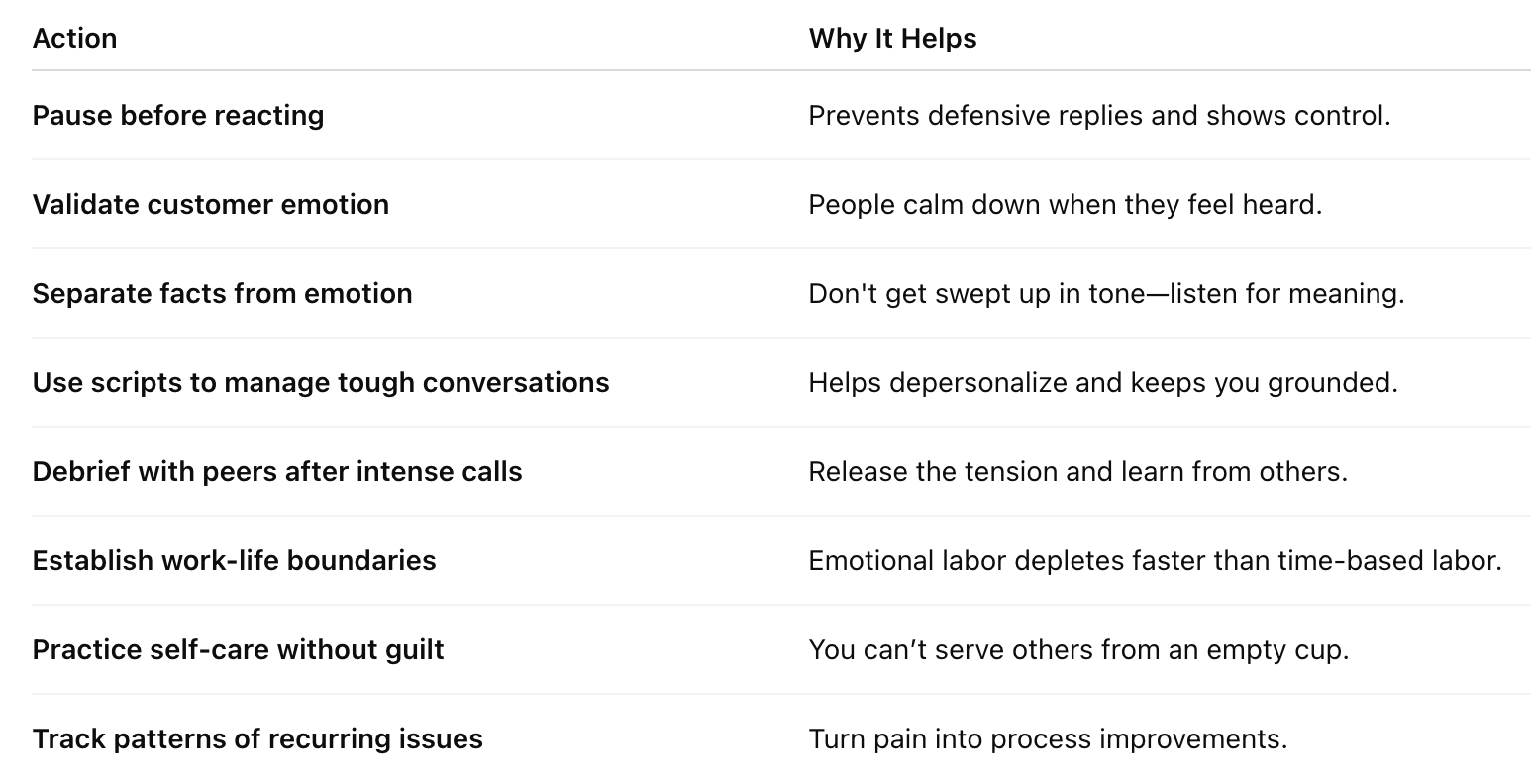
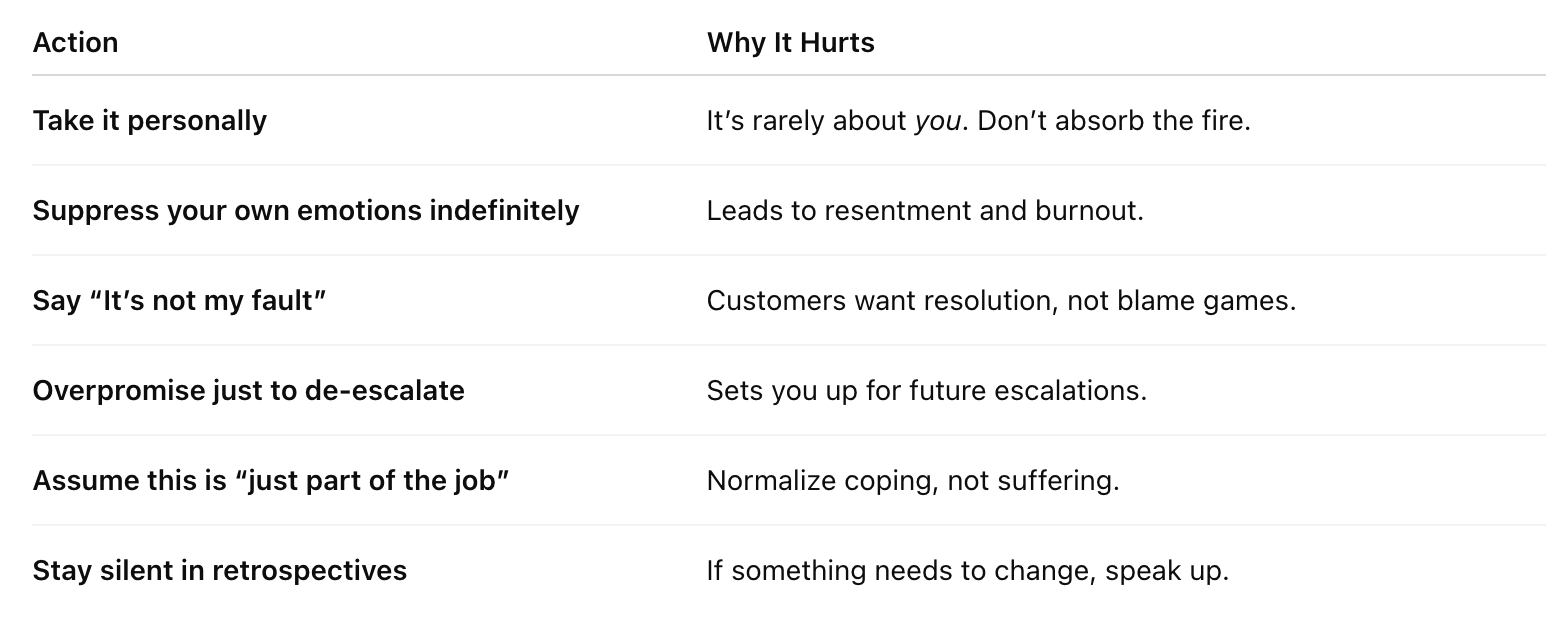
Here’s a personal, practical rubric I’ve used (and shared) to help CSMs process and survive emotional labor:
✅ DOs
❌ DON’Ts
Your Emotional Labor Is a Strategic Asset
You’re not just putting out fires. You’re building trust under pressure.
You’re not just absorbing frustration. You’re translating it into insight, direction, and action.
You’re not “just a CSM.” You’re a diplomat. A fixer. A listener. A negotiator. A therapist. A truth-teller.
You have the hardest job in tech and when done well, the most rewarding.
So give yourself grace. Learn the tools. Build the habits. Surround yourself with people who refill your emotional cup.
And always remember: the weight you carry today is shaping the professional (and the person) you’ll become tomorrow.
That’s how you thrive. That’s how you lead.
I really appreciate the Scenarios because they are real-world realities for all Customer Success Managers.
Out of all the "strategies" on how to be effective and efficient as a CSM, don't forget the ones hardly no one talks about:
Take your PTO
Take care of yourself
This one surely resonates with me, Arinze!